|
Recent News
see older
→
Teaching
- EECS 270: Introduction to Logic Design
(F'13)
- EECS 370: Introduction to Computer Organization
(W'14)
- EECS 373: Design of Microprocessor Based Systems
(F'15,
W'15,
F'14,
F'12,
F'11,
F'10)
- EECS 496: Major Design Experience/Professionalism
(F'16)
- EECS 582: Advanced Operating Systems
(W'15,
W'13,
W'12,
W'11)
- EECS 598: Wireless Sensor Networks: Technology, Systems, and Applications
(W'10)
Service (*=co-chair; †=chair; ‡=general co-chair)
- 2024 TPCs:
ACM e-Energy,
EWSN‡,
IPSN,
OSDI
- 2023 TPCs:
ACM BuildSys,
ACM e-Energy,
IPSN Journal Track*,
MobiCom,
MobiSys
- 2022 TPCs:
MobiSys
- 2021 TPCs:
SIGMOBILE Test-of-Time Award†,
SIGBED Early Career Award
- 2020 TPCs:
SIGMOBILE Test-of-Time Award,
SIGBED Early Career Award
- 2019 TPCs:
SenSys,
EWSN
- 2018 TPCs:
MobiSys*,
ACM Open IoT Day,
SenSys Test-of-Time Award
- 2017 TPCs:
IPSN*,
BuildSys*,
ESWEEK IoT Day†,
SenSys Test-of-Time Award
- 2016 TPCs:
HotMobile†,
NextMote,
SenSys
- 2015 TPCs:
NSDI,
MobiSys,
HotWireless,
BuildSys
- 2014 TPCs:
SenSys*,
HotMobile,
NSDI,
MobiSys,
MobiCom,
SRIF,
HotWireless,
HotPower
BuildSys
- 2013 TPCs:
IPSN,
MobiSys,
MobiCom,
HotPower,
Swarm*
- 2012 TPCs:
Green Computing,
MobiSys,
SenSys,
MedCOMM,
mHealthSys
- 2011 TPCs:
HotPower*,
MobiCom,
IPSN,
WWW,
Buildsys,
PhoneSense,
Mobile Sensing
- 2010 TPCs:
MobiCom,
MobiHoc,
MobiHeld,
Green-Net,
BuildSys,
HotEmNets,
eEnergy,
IPSN/SPOTS
- 2010 Editorial Boards:
IEEE
Pervasive Comp. (Guest Ed.),
Embedded Systems
Letters (Assoc. Ed.)
- 2009 TPCs:
BuildSys
Selected Honors & Awards
Graduate Students
Alumni
- Stephen Xia (Postdoc'23) → Asst. Professor, Northwestern University
- Ambuj Varshney (Postdoc'22; ABB/HvB Fellow) → Asst. Professor, National University of Singapore
- Thomas Schmid
(Postdoc'10; CRA/CI Fellow) → Asst. Professor, University of Utah
- Thomas Zachariah (PhD'23: "Liberating the Siloed Gateway"; NSF Honorable Mention)
- Josh Adkins (PhD'22: "Sensing as a Shared-Utility"; NSF Fellow) → nLine, Inc.
- Neal Jackson (PhD'22: Design of Energy Harvesting Systems; NSF Honorable Mention) → Blue Iris Labs
- Noah Klugman (PhD'21: "Speaking Truth to Power"; NSF Honorable Mention) → nLine, Inc.
- Meghan Clark (PhD'21: "HCI for Spaces"; NSF Fellow, MSFT Womens' Scholar; PhD) → Resideo
- Pat Pannuto (PhD'20: "MBus"; NSF/NDSEG/QInF Fellow) → Asst. Professor, UCSD
- Branden Ghena (PhD'20: "IoT Wireless Networks"; NSF Fellow) → Asst. Professor, Northwestern
- Will Huang (PhD'20:"Sensing Contacts, Coughs, and Hand Hygiene") → Blue Iris Labs
- Sam DeBruin (PhD'17: "Plug-Load Metering"; NSF Fellow) → SkySpecs
- Brad Campbell
(PhD'17: "Perpetual
Sensing"; QInF Fellow) → Asst. Professor, University of
Virginia
- Ben Kempke
(PhD'17: "Improving
RF Localization") → Kempke Engineering
- Ye-Sheng Kuo
(PhD'15: "Software-Defined
Lighting") → Samsara Networks
- Aaron Schulman (PhD'13, Visiting from University of Maryland) → Asst. Professor, UCSD
Current Research Projects
-
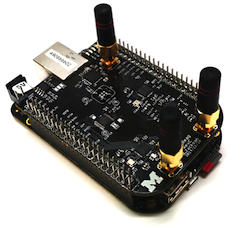 IoT/Swarm. The Internet of Things
will bring a trillion new wireless, embedded Internet hosts online
within a decade or two. Many of these devices will be highly
constrained in their energy, connectivity, and computational capacity,
raising new research questions about how to build secure applications
that span the embedded, mobile/gateway, and cloud platforms. We're
exploring the IoT design space, from system architecture directions
for the Swarm to circuits and systems with a focus on modular design
of ultralow-power components to application runtimes for the IoT to
Internet and application layer gateways to IoT services like
localization. Our goal is to research how we should build devices and
software that survive and thrive in this not-too-distant future. IoT/Swarm. The Internet of Things
will bring a trillion new wireless, embedded Internet hosts online
within a decade or two. Many of these devices will be highly
constrained in their energy, connectivity, and computational capacity,
raising new research questions about how to build secure applications
that span the embedded, mobile/gateway, and cloud platforms. We're
exploring the IoT design space, from system architecture directions
for the Swarm to circuits and systems with a focus on modular design
of ultralow-power components to application runtimes for the IoT to
Internet and application layer gateways to IoT services like
localization. Our goal is to research how we should build devices and
software that survive and thrive in this not-too-distant future.
[
SWEC'15
| HotMobile'15
| MobiCom'14
| VLSI'14
| D&T'14
]
-
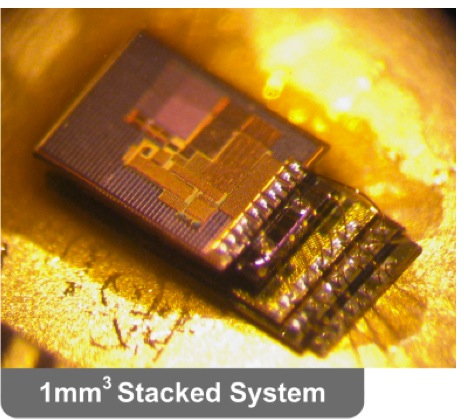
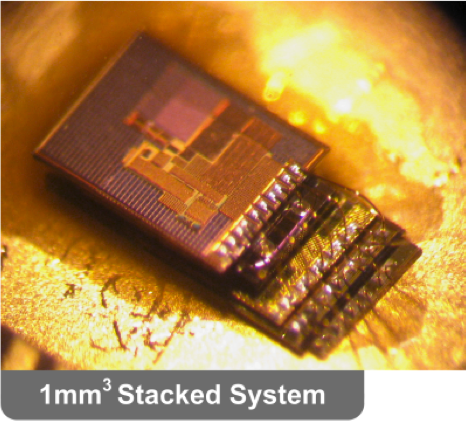 M3. The goal of the
Michigan Micro Mote (M3) project is to finally realize the
Smart Dust vision: networks of integrated, autonomous,
energy-harvesting nodes that can sense the environment and deliver
their data over a wireless mesh network. The concrete goal of the
project is to: (1) create sensor nodes that are cubic-mm in size, (2)
draw ~10 nW, and (3) deliver data every few seconds or minutes. This
requires advances in every layer of the system stack -- circuits to
memory to processor to timers to radios to interconnects to packaging
to software to protocols to programming models. If successful, this
represents a 1,000-10,000 fold improvement over the state-of-the-art
in size and power, compared with circa 2010 systems.
CubeWorks is commercializing this
technology. M3. The goal of the
Michigan Micro Mote (M3) project is to finally realize the
Smart Dust vision: networks of integrated, autonomous,
energy-harvesting nodes that can sense the environment and deliver
their data over a wireless mesh network. The concrete goal of the
project is to: (1) create sensor nodes that are cubic-mm in size, (2)
draw ~10 nW, and (3) deliver data every few seconds or minutes. This
requires advances in every layer of the system stack -- circuits to
memory to processor to timers to radios to interconnects to packaging
to software to protocols to programming models. If successful, this
represents a 1,000-10,000 fold improvement over the state-of-the-art
in size and power, compared with circa 2010 systems.
CubeWorks is commercializing this
technology.
[ IEEE MICRO'16
| JSTS'16
| ISCA'15
| CICC'14
| VLSI'14
| JSSC'13
| ISSCC'12
]
-
Energy and Water Metering.
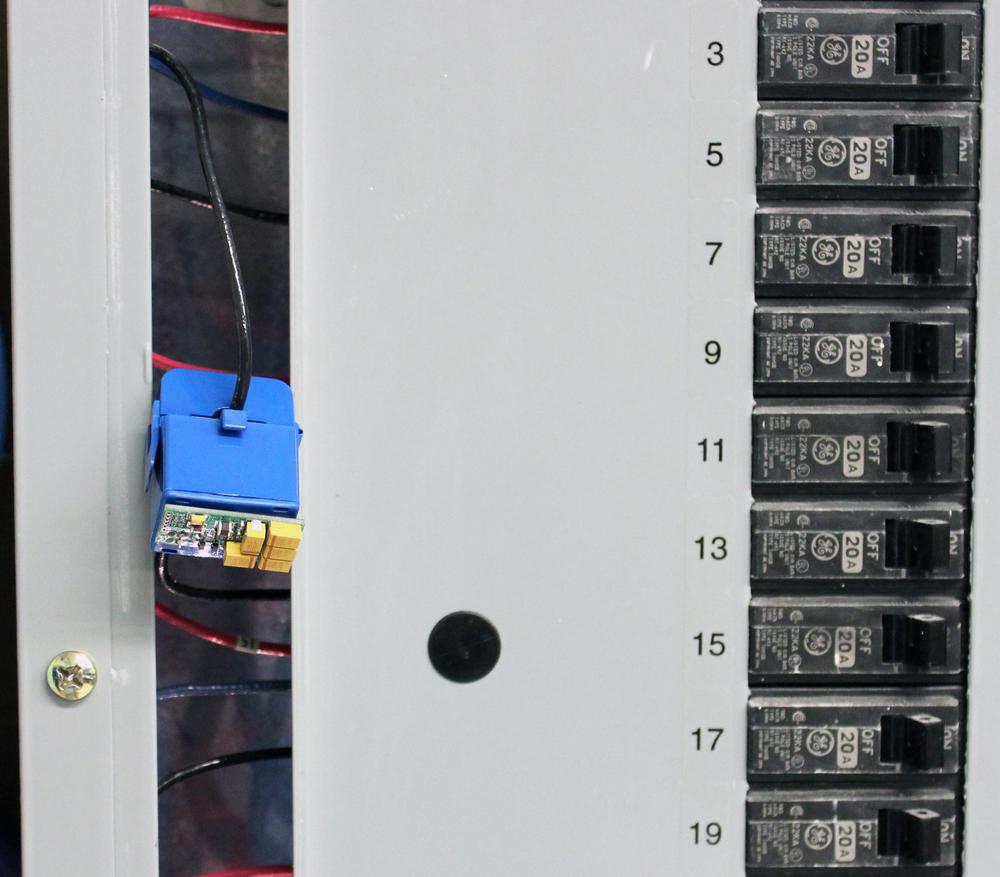
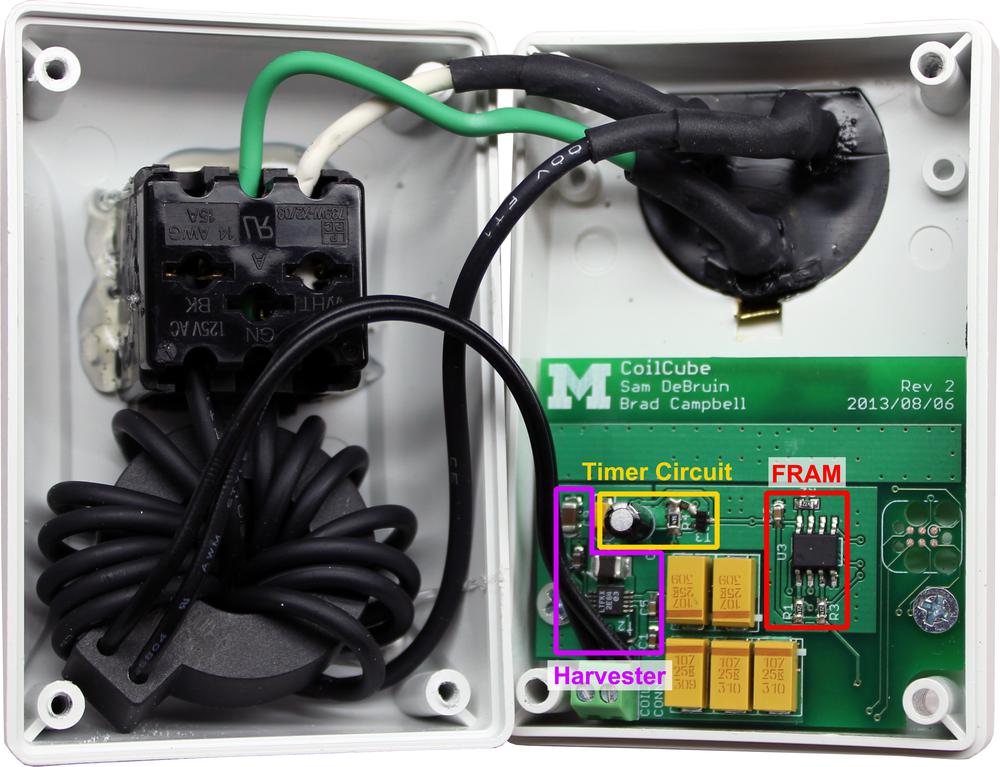
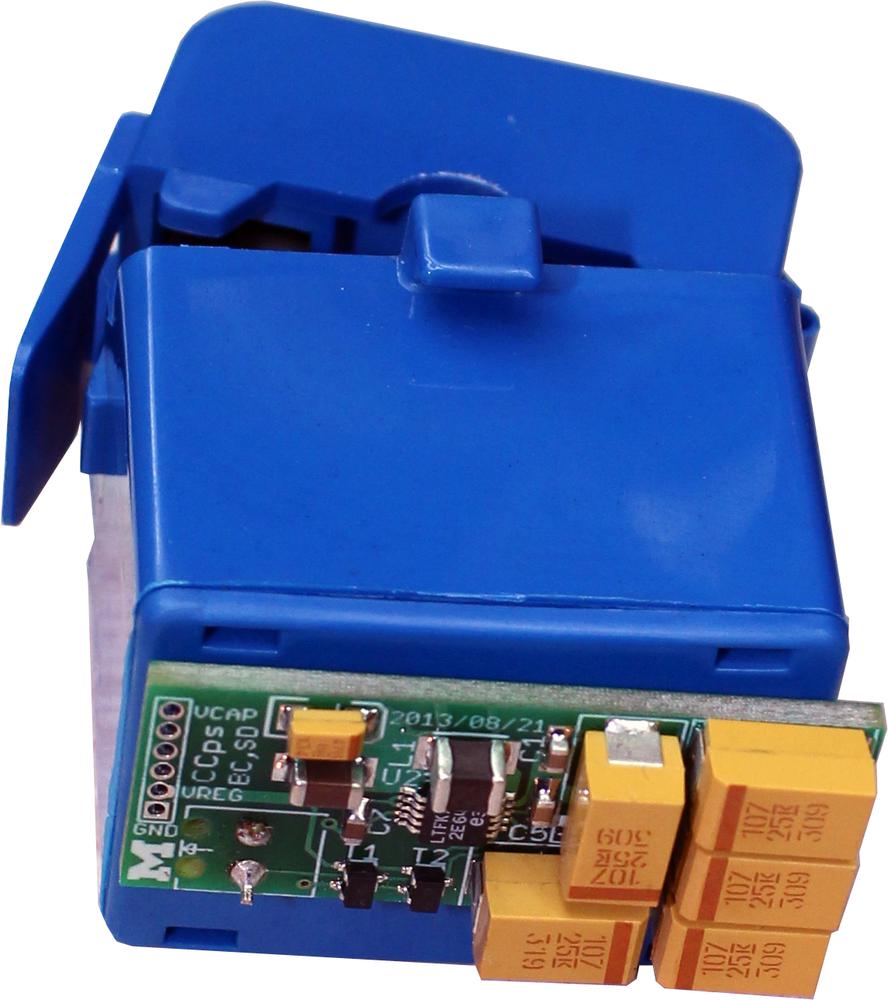
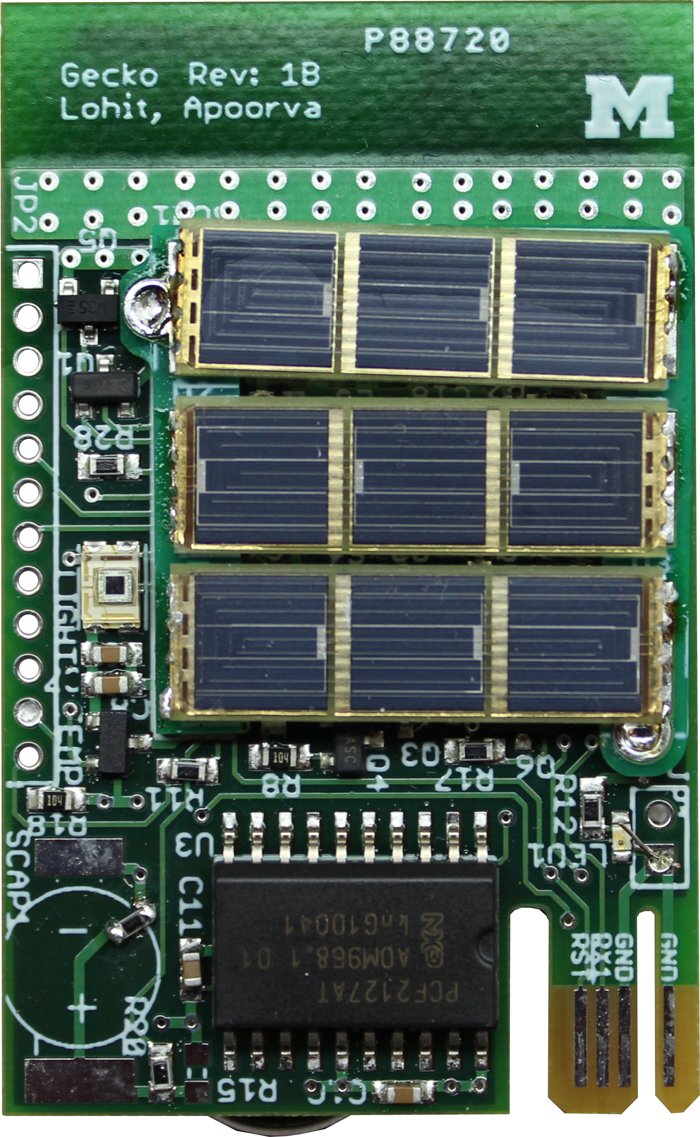 Federal sustainability goals
mandate that 50% of U.S. commercial buildings become net-zero energy
by 2050. A range of options exists to achieve this goal, but financial
concerns require a data-driven, empirically-validated
approach. However, critical gaps exist in the measurement technology,
and indoor climate control science, needed to benchmark competing
options, prioritize efficiency investments, and ensure occupant
comfort. To address these challenges, we are researching a range of
scalable resource metering and monitoring techniques, from plug-load
metering to non-intrusive load monitoring. One recent thrust includes
Monjolo (a "peel-and-stick" sensor that can be affixed to
everyday objects, like a ceiling light, shower head, or range top, to
infer their contributions to whole-building resource consumption).
The sensors monitor the ambient conditions around a load and, using
statistical methods, correlate those conditions with readings from
existing electricity, gas, or water meters, providing individual
estimates without intrusive metering. The key insight is that the
transfer and use of energy (and other resources) usually emits energy,
often in a different domain, and that this emitted energy is often
enough to intermittently power simple, energy harvesting sensors whose
duty cycle is proportional to the energy being transferred or used. Federal sustainability goals
mandate that 50% of U.S. commercial buildings become net-zero energy
by 2050. A range of options exists to achieve this goal, but financial
concerns require a data-driven, empirically-validated
approach. However, critical gaps exist in the measurement technology,
and indoor climate control science, needed to benchmark competing
options, prioritize efficiency investments, and ensure occupant
comfort. To address these challenges, we are researching a range of
scalable resource metering and monitoring techniques, from plug-load
metering to non-intrusive load monitoring. One recent thrust includes
Monjolo (a "peel-and-stick" sensor that can be affixed to
everyday objects, like a ceiling light, shower head, or range top, to
infer their contributions to whole-building resource consumption).
The sensors monitor the ambient conditions around a load and, using
statistical methods, correlate those conditions with readings from
existing electricity, gas, or water meters, providing individual
estimates without intrusive metering. The key insight is that the
transfer and use of energy (and other resources) usually emits energy,
often in a different domain, and that this emitted energy is often
enough to intermittently power simple, energy harvesting sensors whose
duty cycle is proportional to the energy being transferred or used.
[ RTSS'14
| BuildSys'14
| ENSsys'14
| e-Energy'14
| SenSys'13
| IPSN'12
| XRDS'11
| Buildsys'10
| SenSys'09
| IPSN'09
]
-
Localization. Accurately locating people, places, and things,
particularly in indoor settings, will enable a variety of new
applications and services. We are exploring a number of fronts in
this space:
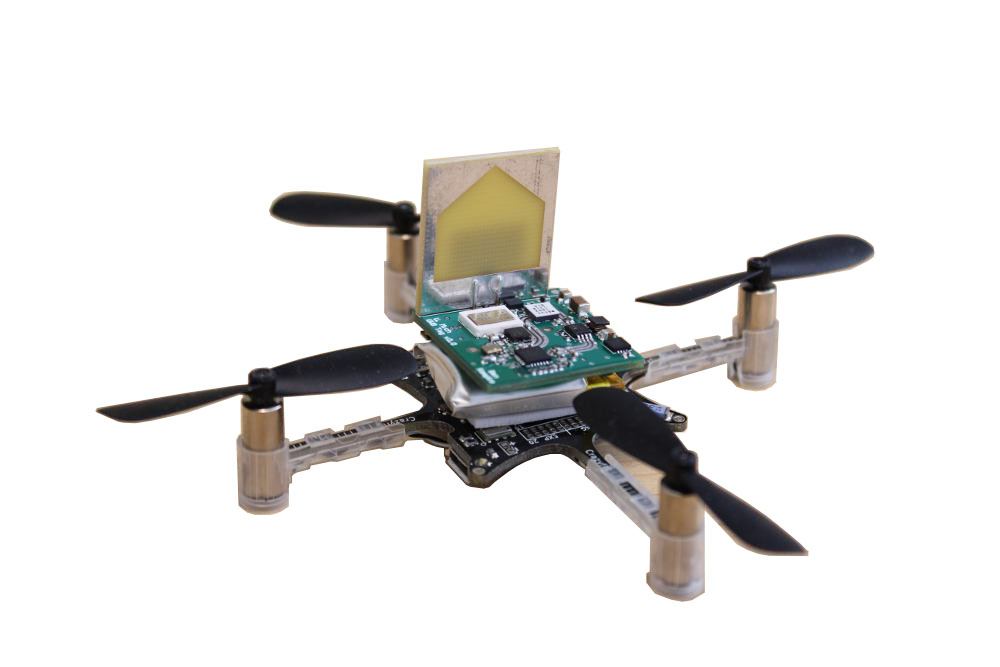 (i) The Harmonia/Harmonium project is
exploring the design space of localizing and tracking fast-moving
aerial objects in indoor settings using RF time-of-arrival techniques.
Our recent results show that it is possible to precisely track tiny
airborne drones with a small (1.5 cc), lightweight (3 g), and low
power (75 mW) system using a novel ultrawideband (UWB) transmitter and
receiver design that support fast updates (19-56 Hz) and inexpensive
tags ($4.50). Our first design mixes a square wave and sine wave to
generate a wideband signal (the Fourier coefficients) and recovers
them using a bandstitching receiver that uses a frequency-stepped,
narrowband radio to reconstruct the wideband signal
[HotWireless'14],
reprinted
[MC2R'14].
Harmonium, a subsequent design, works through walls and in the
presence of narrowband interferers that knock out commercial UWB
ranging systems [IPSN'16]. Harmonium employs novel
ultrawideband pulse generators that occupy several GHz of bandwidth
and provide positioning accuracy to the decimeter-level. This
bandstitched receiver design allows multi-GHz resolution with the cost
of narrowband FM receivers. (i) The Harmonia/Harmonium project is
exploring the design space of localizing and tracking fast-moving
aerial objects in indoor settings using RF time-of-arrival techniques.
Our recent results show that it is possible to precisely track tiny
airborne drones with a small (1.5 cc), lightweight (3 g), and low
power (75 mW) system using a novel ultrawideband (UWB) transmitter and
receiver design that support fast updates (19-56 Hz) and inexpensive
tags ($4.50). Our first design mixes a square wave and sine wave to
generate a wideband signal (the Fourier coefficients) and recovers
them using a bandstitching receiver that uses a frequency-stepped,
narrowband radio to reconstruct the wideband signal
[HotWireless'14],
reprinted
[MC2R'14].
Harmonium, a subsequent design, works through walls and in the
presence of narrowband interferers that knock out commercial UWB
ranging systems [IPSN'16]. Harmonium employs novel
ultrawideband pulse generators that occupy several GHz of bandwidth
and provide positioning accuracy to the decimeter-level. This
bandstitched receiver design allows multi-GHz resolution with the cost
of narrowband FM receivers.
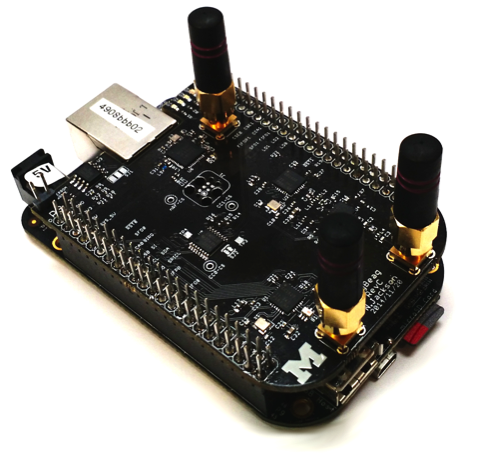
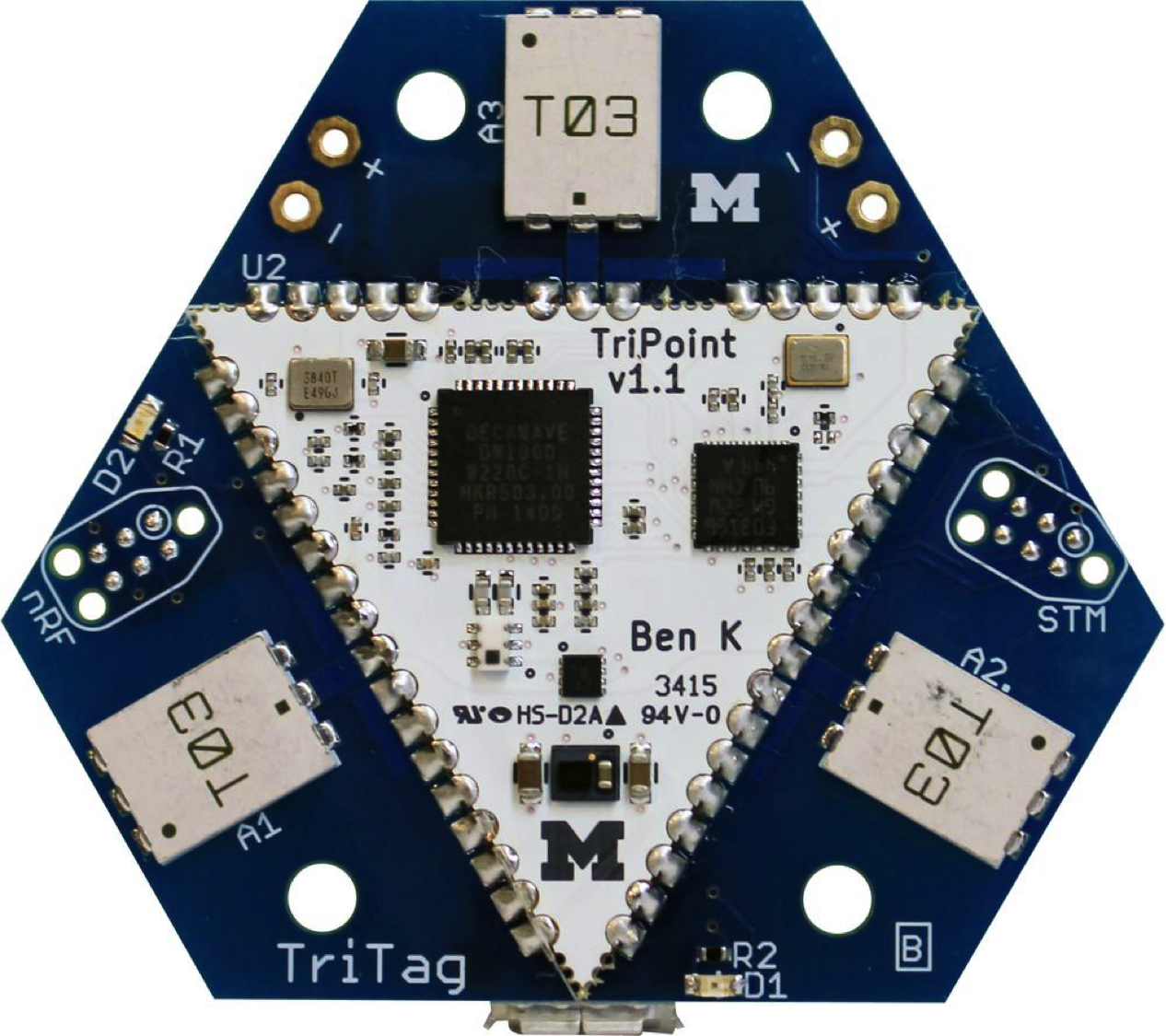
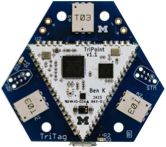 (ii) The PolyPoint/SurePoint system is
exploring the performance of 2-way RF Time-of-Flight (ToF)
ranging-based localization systems that use IEEE 802.15.4-compliant
UWB timing operations (based on the
DecaWave DW1000
chip). The PolyPoint node hardware augments this chip with a 3-way RF
switch connected to three antennas to provide antenna diversity and
reduce the effects of RF polarization.
An Atum module (with ARM
Cortex-M3) schedules ranging operations and calculates the range
estimates, which are then offloaded for trilateration processing. The
ranging operations are repeated 27 times: (3 tag antennas)×(3
anchor antennas)×(3 UWB channels)
[HotWireless'15, where
it won the "Potential for Test of Time 2025 Award"]. PolyPoint placed
3rd in the infrastructure-based category and 4th overall at the
2015 Microsoft
Indoor Localization Competition
[IPSN'15]. SurePoint extends
this work to improve ranging accuracy and ranging network formation
speed while also introducing UWB constructive interference
[SenSys'16].
SurePoint has been used to demonstrate a new method for
calibration-free, infrastructure- free localization in sensor
networks [IPSN'17]. (ii) The PolyPoint/SurePoint system is
exploring the performance of 2-way RF Time-of-Flight (ToF)
ranging-based localization systems that use IEEE 802.15.4-compliant
UWB timing operations (based on the
DecaWave DW1000
chip). The PolyPoint node hardware augments this chip with a 3-way RF
switch connected to three antennas to provide antenna diversity and
reduce the effects of RF polarization.
An Atum module (with ARM
Cortex-M3) schedules ranging operations and calculates the range
estimates, which are then offloaded for trilateration processing. The
ranging operations are repeated 27 times: (3 tag antennas)×(3
anchor antennas)×(3 UWB channels)
[HotWireless'15, where
it won the "Potential for Test of Time 2025 Award"]. PolyPoint placed
3rd in the infrastructure-based category and 4th overall at the
2015 Microsoft
Indoor Localization Competition
[IPSN'15]. SurePoint extends
this work to improve ranging accuracy and ranging network formation
speed while also introducing UWB constructive interference
[SenSys'16].
SurePoint has been used to demonstrate a new method for
calibration-free, infrastructure- free localization in sensor
networks [IPSN'17].
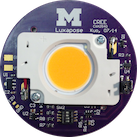 (iii) The Luxapose project is exploring the indoor positioning
problem with unmodified smartphones and slightly-modified commercial
LED luminaires. The luminaires, modified to allow rapid, on-off
keying, transmit their identifiers and/or locations encoded in
human-imperceptible optical pulses. A camera-equipped smartphone,
using just a single image frame capture, can detect the presence of
the luminaires in the image, decode their transmitted identifiers
and/or locations, and determine the smartphone's location and
orientation relative to the luminaires. The key insights underlying
this work are (i) the driver circuits of emerging LED lighting systems
can be easily modified to transmit data through on-off keying; (ii)
the rolling shutter effect of CMOS imagers can be leveraged to receive
many bits of data encoded in the optical transmissions with just a
single frame capture, (iii) a camera is intrinsically an
angle-of-arrival sensor, so the projection of multiple nearby light
sources with known positions onto a camera's image plane can be framed
as an instance of a sufficiently-constrained angle-of-arrival
localization problem, and (iv) this problem can be solved with
optimization techniques, yielding accurate indoor positioning: 10 cm
position error and 10 degree heading error at the 90th percentile
[MobiCom'14].
Luxapose is one of the applications that run on software-defined
lighting [VLCS'14].
(iii) The Luxapose project is exploring the indoor positioning
problem with unmodified smartphones and slightly-modified commercial
LED luminaires. The luminaires, modified to allow rapid, on-off
keying, transmit their identifiers and/or locations encoded in
human-imperceptible optical pulses. A camera-equipped smartphone,
using just a single image frame capture, can detect the presence of
the luminaires in the image, decode their transmitted identifiers
and/or locations, and determine the smartphone's location and
orientation relative to the luminaires. The key insights underlying
this work are (i) the driver circuits of emerging LED lighting systems
can be easily modified to transmit data through on-off keying; (ii)
the rolling shutter effect of CMOS imagers can be leveraged to receive
many bits of data encoded in the optical transmissions with just a
single frame capture, (iii) a camera is intrinsically an
angle-of-arrival sensor, so the projection of multiple nearby light
sources with known positions onto a camera's image plane can be framed
as an instance of a sufficiently-constrained angle-of-arrival
localization problem, and (iv) this problem can be solved with
optimization techniques, yielding accurate indoor positioning: 10 cm
position error and 10 degree heading error at the 90th percentile
[MobiCom'14].
Luxapose is one of the applications that run on software-defined
lighting [VLCS'14].
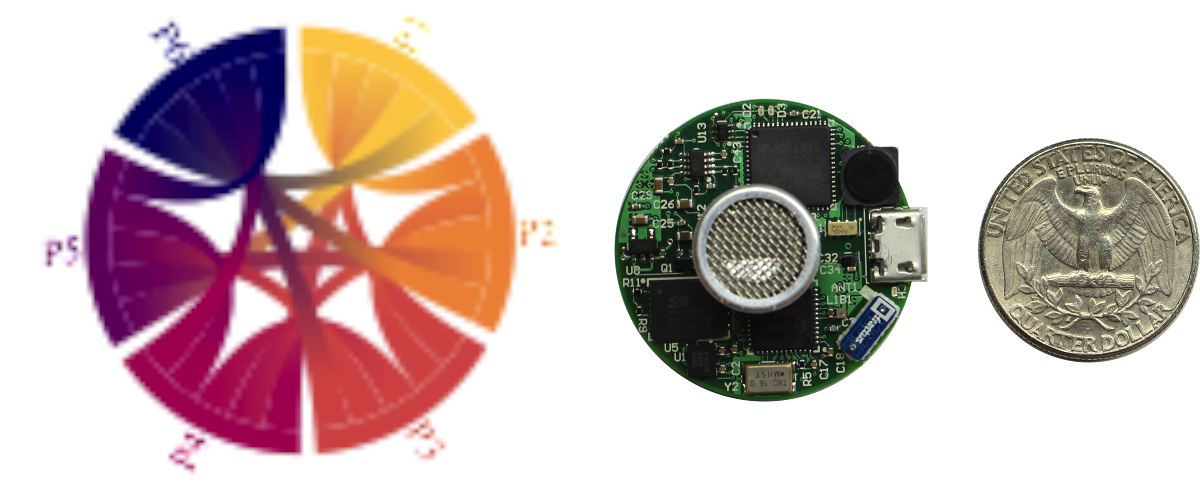
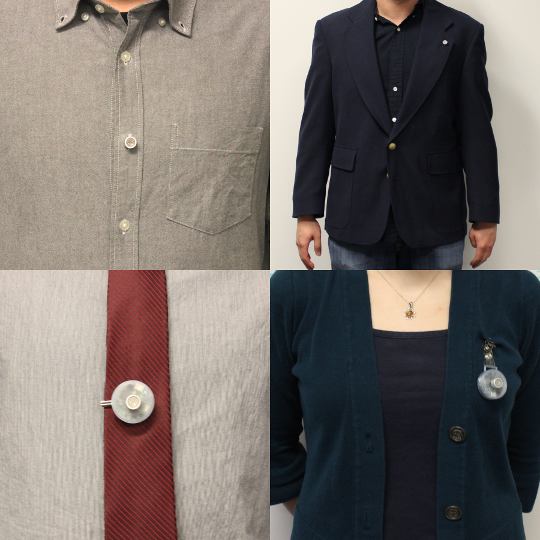 (iv) The Opo Project seeks to capture
the nature of face-to-face human interactions in natural settings with
high spatial and temporal fidelity. This information allows us
understand real-world social dynamics and their implications on
epidemiology, informal informational networks, and childhood social
development. Key to enabling this work is an ultralow-power system
that can detect face-to-face interactions on a sub-milliwatt power
budget using a new ultrasonic wakeup radio that can be built from
commodity components. With very low power draw, sensor nodes can be
miniaturized to the point that they are the size of a large lapel pin,
yet keep a lifetime of over a week with a Chiclet-sized battery. Data
collected using recent versions of this system are recovered using
Bluetooth Low Energy and a smart phone hosted gateway application
[SenSys'14].
(iv) The Opo Project seeks to capture
the nature of face-to-face human interactions in natural settings with
high spatial and temporal fidelity. This information allows us
understand real-world social dynamics and their implications on
epidemiology, informal informational networks, and childhood social
development. Key to enabling this work is an ultralow-power system
that can detect face-to-face interactions on a sub-milliwatt power
budget using a new ultrasonic wakeup radio that can be built from
commodity components. With very low power draw, sensor nodes can be
miniaturized to the point that they are the size of a large lapel pin,
yet keep a lifetime of over a week with a Chiclet-sized battery. Data
collected using recent versions of this system are recovered using
Bluetooth Low Energy and a smart phone hosted gateway application
[SenSys'14].
If these projects sound interesting to you, and you have been
admitted to the CSE or ECE Ph.D. program at Michigan, send me an
e-mail. Some of my older projects are described on my Berkeley
homepage.
Completed Research Projects
-
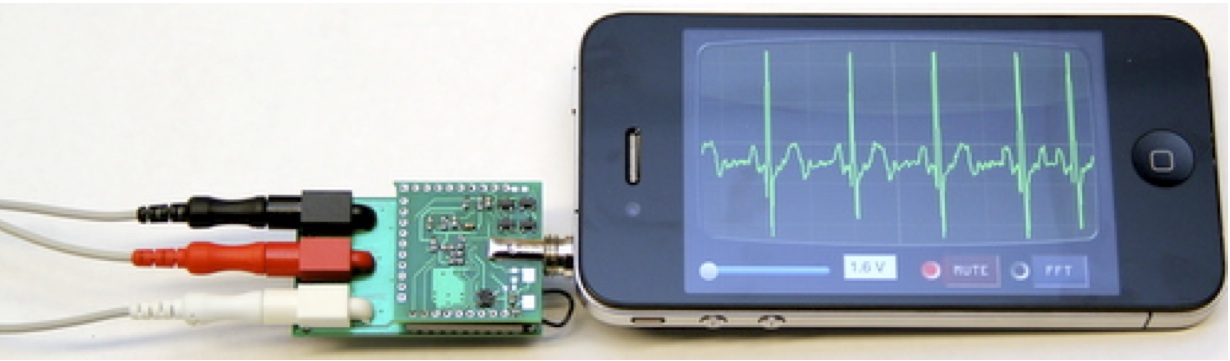 HiJack. HiJack is a
hardware/software platform for creating cubic-inch sensor peripherals
for the mobile phone. HiJack devices harvest power and steal bandwidth
from the mobile phone's headset interface. Several energy harvesting
power supply designs are possible, with tradeoffs in efficiency, cost,
and complexity. Our initial design coupled a Texas Instruments MSP430
microcontroller with an iPhone 3G/3GS/4G, iPod Touch, or iPad
[DEV'10]. This design won
the ISLPED low power design contest in 2010
[ISLPED'10] and was
distributed by
Seeed Studio to academic, industrial, and hobbyist users in over 50 countries and on 6 continents.
EnergyMicro (now SiLabs) ported the design to their Tiny Gecko
[AN0054].
NXP Semiconductor ported HiJack to their LPC800 family,
continuing support for iOS and adding support for Android (Samsung Galaxy S3).
NXP markets their version as Quick-Jack
[OM13069], which is available through
Digi-Key,
Mouser,
Newark,
Farnell, and others.
We have also explored an alternate design point, called AudioDAQ, that
uses the microphone bias voltage to supply low-power sensors like EKG,
and uses the same mic line to provide a data path back into the phone,
with some modulation of the analog signal to ensure it passes through
the microphone's filters
[SenSys'12].
The HiJack platform has enabled a new class of small and inexpensive
phone-centric peripherals that support plug-and-play operation. At
Michigan, HiJack has served as the basis for several low-power sensor
and signal conditioning front-ends including EKG (3-lead and 2-hand),
temperature, gas concentration (CO, NOx, O3, and SO2), and soil
moisture, as well as an energy harvesting demonstration platform
[XRDS'11]. HiJack
has supported incentive-driven smoking cessation research
[JNTR'14].
Outside of Michigan, HiJack has influenced or been directly used to
detect HIV and syphilis biomarkers,
enable health and wellness,
measure and map radiation fields,
and support mobile payment systems. HiJack. HiJack is a
hardware/software platform for creating cubic-inch sensor peripherals
for the mobile phone. HiJack devices harvest power and steal bandwidth
from the mobile phone's headset interface. Several energy harvesting
power supply designs are possible, with tradeoffs in efficiency, cost,
and complexity. Our initial design coupled a Texas Instruments MSP430
microcontroller with an iPhone 3G/3GS/4G, iPod Touch, or iPad
[DEV'10]. This design won
the ISLPED low power design contest in 2010
[ISLPED'10] and was
distributed by
Seeed Studio to academic, industrial, and hobbyist users in over 50 countries and on 6 continents.
EnergyMicro (now SiLabs) ported the design to their Tiny Gecko
[AN0054].
NXP Semiconductor ported HiJack to their LPC800 family,
continuing support for iOS and adding support for Android (Samsung Galaxy S3).
NXP markets their version as Quick-Jack
[OM13069], which is available through
Digi-Key,
Mouser,
Newark,
Farnell, and others.
We have also explored an alternate design point, called AudioDAQ, that
uses the microphone bias voltage to supply low-power sensors like EKG,
and uses the same mic line to provide a data path back into the phone,
with some modulation of the analog signal to ensure it passes through
the microphone's filters
[SenSys'12].
The HiJack platform has enabled a new class of small and inexpensive
phone-centric peripherals that support plug-and-play operation. At
Michigan, HiJack has served as the basis for several low-power sensor
and signal conditioning front-ends including EKG (3-lead and 2-hand),
temperature, gas concentration (CO, NOx, O3, and SO2), and soil
moisture, as well as an energy harvesting demonstration platform
[XRDS'11]. HiJack
has supported incentive-driven smoking cessation research
[JNTR'14].
Outside of Michigan, HiJack has influenced or been directly used to
detect HIV and syphilis biomarkers,
enable health and wellness,
measure and map radiation fields,
and support mobile payment systems.
-
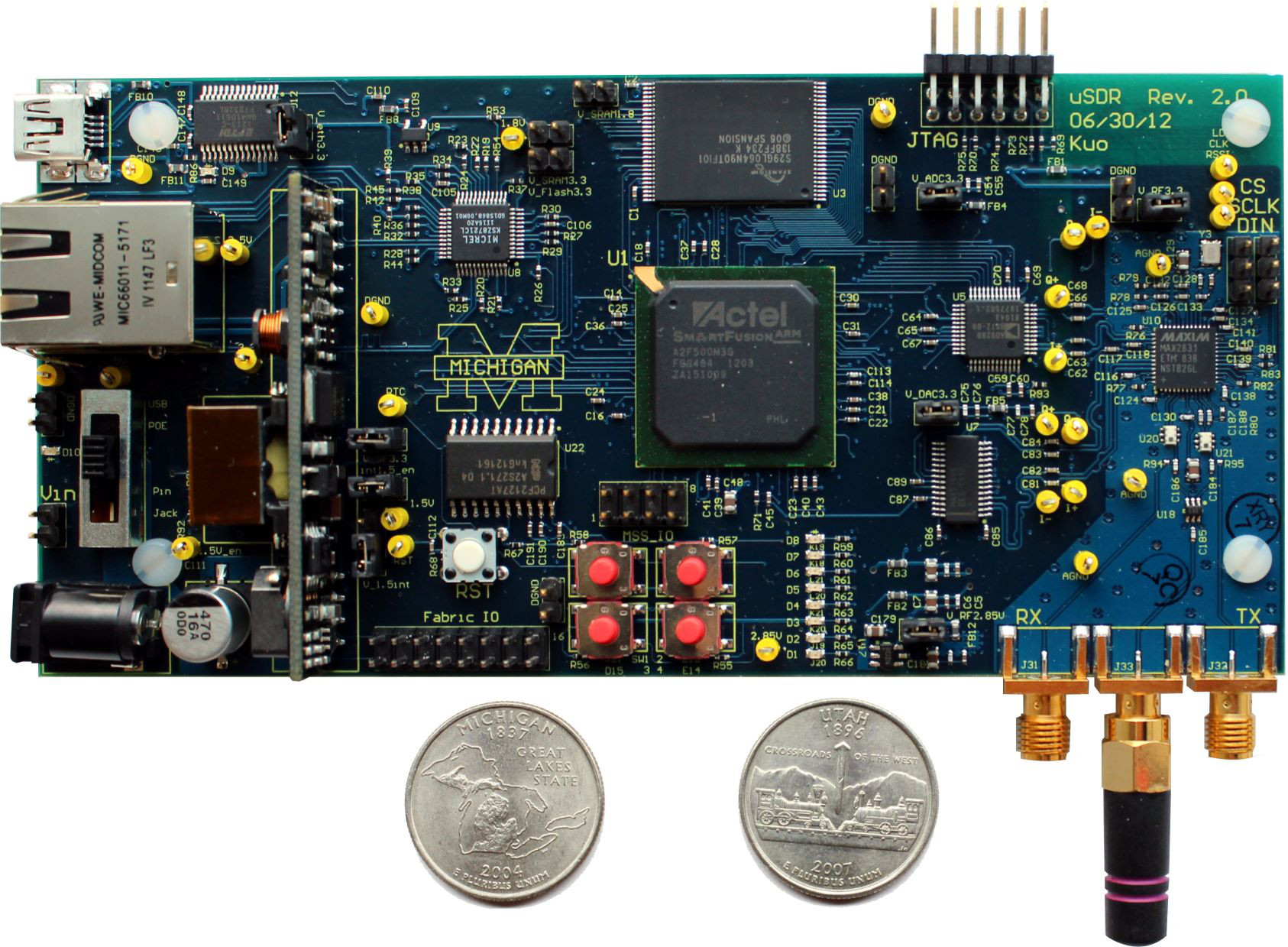
Low-Power Software Radio Architectures. "By about 2020
software radios will have become the standard technology for
commercial, as well as military, radios, employed in a range of
devices, from battery-powered sensors and hand-held devices to
plugged-in devices (such as base stations),"
claims
BBN's Craig Partridge. However, one of the chief impediments to
realizing this future is that today's software radios are large,
expensive, and power-hungry, and so they're poorly-suited to
battery-power and hand-held devices. This project explores
clean-slate system architectures for software-defined radios, ranging
from highly-programmble radios to RF front-ends with reconfigurable
hardware baseband processing to simple RF front-ends with pure
software baseband processing. Our chief aim is to make software
radios small, inexpensive, and low-power. Today, we have an
802.15.4-compatible SDR platform that's just 3"x5" and costs around
$100. The power figures are still not in. It will soon be an open
platform for other researchers, and it will allow us to explore the
range of architectural tradeoffs necessary to realize pervasive SDR
systems.
[ SenSys'12
| Allerton'12
| HotNets'10
]
-
Talking Book. ICT has the potential for deep social impact in
developing regions but today's typical devices - laptops, mobile
phones, and similar systems - are often still too expensive for many
scenarios. The thesis of this work is that custom ICs can enable a new
tier of low-cost information access devices with a price point that
will make them widely accessible. And, with control over the silicon,
these systems can economically address many other challenges. To
evaluate these ideas, we focus on a deceptively simple problem -
low-cost information access for illiterate populations through audio
recordings - and explore how custom silicon allows us to reduce cost,
lower power, leverage conventional infrastructure in unconventional
ways, and optimize the interface for usability. In particular, we
explore how a rural audio computer can be designed around just three
chips, use an inexpensive capacitive touch interface, employ inductive
communications for peer-to-peer data transfer, and employ content
download over GSM voice and FM broadcast as two wide area options. The
resulting design point – enabled by aggressive silicon integration –
affords a device that can be built for less than $10. We are working
with Literacy Bridge, a
Washington state non-profit, to initially bring this technology to
improve child and maternal health for 25,000 people across Ghana.
[ TCAS-I'13
| DEV'10
]
Publications (*publications prior to 2010
also available)
⟨⟨ 2024 ⟩⟩
- "Nebula: A Privacy-First Platform for Data Backhaul,"
Jean-Luc Watson, Tess Despres, Alvin Tan, Shishir Patil, Prabal Dutta, and Raluca Ada Popa,
In Proc. of the 45th IEEE Symposium on Security & Privacy (Oakland), San Francisco, CA, May 20-23, 2024.
To appear.
⟨⟨ 2023 ⟩⟩
- "Downwind Fire and Smoke Detection during a Controlled Burn—Analyzing the Feasibility and Robustness of Several Downwind Wildfire Sensing Modalities through Real World Applications,"
Patrick Chwalek, Hall Chen, Prabal Dutta, Joshua Dimon, Sukh Singh, Constance Chiang, and Thomas Azwell,
In Fire Journal, 6(9), Sep. 11, 2023.
- "DeTagTive: Linking MACs to Protect Against Malicious BLE Trackers,"
Tess Despres, Noelle Davis, David Wagner, and Prabal Dutta,
In Second SIGCOMM Workshop on Situating Network Infrastructure with People, Practices, and Beyond (SNIP2+),
New York City, New York, Sep. 10, 2023.
- "Unleashing Electronics Prototyping (and Beyond): Computational Design for Circuit Boards,"
Richard Lin, Rohit Ramesh, Prabal Dutta, Bjoern Hartmann, and Ankur Mehta,
In CHI'23 Workshop - Beyond Prototyping Boards: Future Paradigms for Electronics Toolkits,
Hamburg, Germany, Apr 23-28, 2023.
-
"Utility Infrastructure Fault Detection and Monitoring,"
Timothy Barat, Zhenhao Chen, and Prabal Dutta,
United States Patent & Trademark Office No. 11,620,181 B2, Apr 4, 2023.
-
"Capacitive Non-Contact Voltage Sensing Method and Apparatus,"
Prabal Dutta, Michael C. Lorek, Brian Andika Purnomo, and Aaron Block,
United States Patent & Trademark Office No. 11,614,469 B2, Mar 28, 2023.
- "TunnelLiFi: Bringing LiFi to Commodity Internet of Things,"
Muhammad Sarmad Mir, Wenqing Yan, Prabal Dutta, Domenico Giustiniano, and Ambuj Varshney,
In The 24th International Workshop on Mobile Computing Systems and Applications (HotMobile'23),
Orange County, CA, Feb. 22-23, 2023.
- "Greyboxing: Towards Domain-specific Representations for Domain-specific Languages in Electronics Design,"
Richard Lin, Rohit Ramesh, Prabal Dutta, Bjoern Hartmann, and Ankur Mehta,
In PLATEAU2023: 13th annual workshop on the intersection of HCI and PL,
Pittsburgh, PA, Feb. 13-14, 2023.
⟨⟨ 2022 ⟩⟩
- "ThingSpeak in the Wild: Exploring 38K Visualizations of IoT Data,"
Thomas Zachariah, Noah Klugman, and Prabal Dutta,
In The Fifth International SenSys+BuildSys Workshop on Data: Acquisition To Analysis (DATA '22),
Boston, MA, Nov. 6, 2022.
- "Computational Support for Multiplicity in Hierarchical Electronics Design,"
Richard Lin, Rohit Ramesh, Prabal Dutta, Bjoern Hartmann, and Ankur Mehta,
In Proceedings of 7th annual ACM Symposium on Computational Fabrication(SCF'22),
Seattle, WA, Oct. 26-28, 2022.
- "ReliaBLE: Towards Reliable Communication via Bluetooth Low Energy Advertisement Networks,"
Thomas Zachariah, Neal Jackson, Branden Ghena, and Prabal Dutta,
In Proceedings of the 2022 International Conference on Embedded Wireless Systems and Networks (EWSN'22),
Linz, Austria, Oct. 3-5, 2022.
-
"POET: Training Neural Networks on Tiny Devices with Integrated Rematerialization and Paging,"
Shishir Patil, Paras Jain, Prabal Dutta, Ion Stoica, and Joey Gonzalez,
In Proceedings of the 39th International Conference on Machine Learning (ICML’22),
Baltimore, Maryland, Jul. 17-23, 2022.
-
"Judo: Addressing the Energy Asymmetry of Wireless Embedded Systems through Tunnel Diode based Wireless Transmitters,"
Ambuj Varshney, Wenqing Yan, and Prabal Dutta,
In Proceedings of the 20th ACM International Conference on Mobile Systems, Applications, and Services (MobiSys’22),
Portland, Oregon, Jun. 25-Jul. 1, 2022.
-
"Where the Sidewalk Ends: Privacy of Opportunistic Backhaul,"
Tess Despres, Shishir Patil, Alvin Tan, Jean-Luc Watson, and Prabal Dutta,
In The 15th European Workshop on Systems Security (EuroSec’22),
Rennes, France, Apr. 5-8, 2022.
-
"Tiered Trust for Useful Embedded Systems Security,"
Hudson Ayers, Prabal Dutta, Philip Levis, Amit Levy, Pat Pannuto, Johnathan Van Why, and Jean-Luc Watson,
In The 15th European Workshop on Systems Security (EuroSec’22),
Rennes, France, Apr. 5-8, 2022.
-
"ARticulate: One-Shot Interactions with Intelligent Assistants in Unfamiliar Smart Spaces Using Augmented Reality,"
Meghan Clark, Mark W. Newman, and Prabal Dutta,
In Proceedings of the ACM on Interactive, Mobile, Wearable and Ubiquitous Technologies (IMWUT),
Vol. 6, No. 1, Article 7. Mar. 2022.
-
"The Internet of Things Still Has a Gateway Problem,"
Thomas Zachariah, Neal Jackson, and Prabal Dutta,
In The 23rd International Workshop on Mobile Computing Systems and Applications (HotMobile'22),
Tempe, AZ, Mar 9-10, 2022.
⟨⟨ 2021 ⟩⟩
-
"Weaving Schematics and Code: Interactive Visual Editing for Hardware Description Languages,"
Richard Lin, Rohit Ramesh, Nikhil Jain, Josephine Koe, Ryan Nuqui, Prabal Dutta, and Bjoern Hartmann
In Proceedings of the ACM User Interface Software and Technology Symposium (UIST'21),
Virtual, Oct 10-13, 2021.
-
"Watching the Grid: Utility-Independent Measurements of Electricity Reliability in Accra, Ghana,"
Noah Klugman, Joshua Adkins, Emily Paszkiewicz, Molly Hickman, Matthew Podolksy, Jay Taneja, and Prabal Dutta,
In Proceedings of the 20th ACM/IEEE Conference on Information Processing in Sensor Networks (IPSN 21), Nashville, TN, May 18-21, 2021.
-
"Non-Contact Voltage Sensing Method and Apparatus,"
Michael Lorek, Aaron Block, and Prabal Dutta
United States Patent & Trademark Office No. 11,002,765 B1, May 11, 2021.
-
"Technical Perspective: Localizing Insects Outdoors,"
Prabal Dutta,
In Communications of the ACM (CACM), Vol. 64, No. 3, Mar 2021.
-
"Measuring office workplace interactions and hand hygiene behaviors through electronic sensors: A feasibility study,"
Paul N. Zivich, Will Huang, Ali Walsh, Prabal Dutta, Marisa Eisenberg, Allison E. Aiello,
In PLoS ONE 16(1): e0243358, Jan. 19, 2021.
⟨⟨ 2020 ⟩⟩
-
"Polymorphic Blocks:
Unifying High-Level Specification and Low-Level Control for Circuit
Board Design,"
Richard Lin, Rohit Ramesh, Connie Chi, Nikhil Jain, Ryan Nuqui,
Prabal Dutta, and Bjoern Hartmann,
In Proceedings of the ACM User Interface Software and
Technology Symposium (UIST'20)
Minneapolis, Minnesota, Oct. 20-23, 2020.
- "SociTrack: Infrastructure-Free Interaction Tracking through Mobile Sensor Networks,"
Andreas Biri, Neal Jackson, Lothar Thiele, Pat Pannuto, and Prabal Dutta,
Proceedings of the 26th Annual International Conference on
Mobile Computing and Networking (MobiCom'20),
London, United
Kingdom, Sep. 21-25, 2020.
-
"CoVista: A Unified View on Privacy Sensitive Mobile Contact Tracing,"
David Culler, Prabal Dutta, Gabe Fierro, Joseph E. Gonzalez, Nathan Pemberton, Johann Schleier-Smith, K. Shankari, Alvin Wan, Thomas Zachariah,
In Bulletin of the IEEE Computer Society Technical Committee on Data Engineering,
Jun., 2020.
-
"Supporting Circuit Design with a Block-Based, Generator Language,"
Richard Lin, Rohit Ramesh, Connie Chi, Nikhil Jain, Prabal Dutta, and Bjoern Hartmann,
In Proceedings of the 2020 CHI Conference on Human Factors in Computing Systems (CHI'20),
Honolulu, Hawaii, Apr. 25-30, 2020.
- "All that GLITTERs: Low-Power Spoof-Resilient Light Anchors for Augmented Reality,"
Rahul Sharma, Adwait Dongare, John Miller, Nicholas Wilkerson, Vyas Sekar, Prabal Dutta, and Anthony Rowe,
In Proceedings of the 19th ACM/IEEE International Conference on Information Processing in Sensor Networks (IPSN'20),
Sydney, Australia, Apr. 21-24, 2020.
- "Browsing the Web of Connectable Things,"
Thomas Zachariah, Joshua Adkins, and Prabal Dutta,
In Proceedings of the 2020 International Conference on Embedded Wireless Systems and Networks (EWSN'20),
Lyon, France, Feb. 17-19, 2020.
⟨⟨ 2019 ⟩⟩
- "Challenge: Unlicensed
LPWANs Are Not Yet the Path to Ubiquitous Connectivity,"
Branden Ghena, Joshua Adkins, Longfei Shangguan, Kyle Jamieson,
Phil Levis, and Prabal Dutta,
In Proceedings of the 25th
Annual International Conference on Mobile Computing and Networking
(MobiCom'19),
Los Cabos, Mexico, Oct. 21-25, 2019.
- "Hardware, Apps, and
Surveys at Scale: Insights from Measuring Grid Reliability in Accra,
Ghana,"
Noah Klugman, Joshua Adkins, Susanna Berkouwer,
Kwame Abrokwah, Ivan Bobashev, Patrick Pannuto, Matthew Podolsky, Aldo
Suseno, Revati Thatte, Catherine Wolfram, Jay Taneja, Prabal
Dutta,
In
Proceedings of the Second ACM Conference on Computing and Sustainable
Societies (COMPASS'19),
Accra, Ghana, Jul. 3-5, 2019.
- "Beyond Schematic Capture:
Meaningful Abstractions for Better Electronics Design
Tools,"
Richard Lin, Rohit Ramesh, Antonio Iannopollo,
Alberto Sangiovanni-Vincentelli, Prabal Dutta, Elad Alon, Bjoern
Hartmann,
In Proceedings of the 2019 ACM Conference on Human Factors
in Computing Systems (CHI'19),
Glasgow, UK, May 4-9, 2019.
- "Capacity over
Capacitance: Exploiting Batteries in Energy Harvesting
Sensors,"
Neal Jackson, Joshua Adkins, and Prabal
Dutta,
In Proceedings of the 18th ACM/IEEE International
Conference on Information Processing in Sensor Networks
(IPSN'19),
Montreal, Canada, Apr. 16-18, 2019.
- "Embedded OSes
Must Embrace Distributed Computing,"
Branden Ghena,
Jean-Luc Watson, and Prabal Dutta,
In 1st International
Workshop on Next-Generation Operating Systems for Cyber-Physical
Systems (NGOSCPS'19),
Montreal, Canada, Apr. 15, 2019.
- "Freeloaders Guide
Through the Google Galaxy,"
Joshua Adkins, Branden Ghena,
and Prabal Dutta,
In The 20th International Workshop on Mobile
Computing Systems and Applications (HotMobile'19),
Santa Cruz,
CA, Feb. 27-28, 2019.
- "Browsing the Web of
Things in Mobile Augmented Reality,"
Thomas Zachariah and
Prabal Dutta,
In The 20th International Workshop on Mobile
Computing Systems and Applications (HotMobile'19),
Santa Cruz,
CA, Feb. 27-28, 2019.
- "The Open INcentive Kit
(OINK): Standardizing the Generation, Comparison, and Deployment of
Incentive Systems,"
Noah Klugman, Santiago Correa, Pat Pannuto, Matthew Podolsky,
Jay Taneja, and Prabal Dutta,
In Proceedings of the 10th International
Conference on Information and Communication Technologies and Development
(ICTD X),
Ahmedabad, India, Jan. 4-7, 2019.
⟨⟨ 2018 ⟩⟩
- "Reconsidering
Batteries in Energy Harvesting Sensing,"
Neal Jackson,
Joshua Adkins, and Prabal Dutta,
In 6th International Workshop
on Energy Harvesting & Energy-Neutral Sensing Systems (ENSsys'18),
Shenzen, China, Nov. 4, 2018.
- "Experience:
Android Resists Liberation from Its Primary Use Case,"
Noah Klugman, Veronica Jacome, Meghan Clark, Matthew Podolsky,
Patrick Pannuto, Neal Jackson, Aley Soud Nassor, Catherine Wolfram,
Duncan Callaway, Jay Taneja, and Prabal Dutta,
In Proceedings of the 24th Annual International Conference on Mobile Computing and Networking (MobiCom'18),
New Delhi, India, Oct. 29-Nov. 2, 2018.
- "A Modular and
Adaptive Architecture for Building Applications with Connected
Devices,"
Pat Pannuto, Wenpeng Wang, Prabal Dutta, and
Bradford Campbell,
In Proceedings of the 1st IEEE
International Conference on Industrial Internet
(ICII'18),
Bellevue, WA, Oct. 21-23, 2018.
- "Signpost: Enabling City-Scale Sensing for Citizens
and Scientists,"
Joshua Adkins, Branden Ghena, and Prabal
Dutta,
In GetMobile: Mobile Computing and Communications
Review (MC2R),
Vol. 22, Issue 3, Sep. 2018.
- "Harmonium: UWB
Pulse Generation with Bandstitched Recovery for Fast, Accurate, and
Robust Localization,"
Pat Pannuto, Benjamin Kempke, Li-Xuan Chuo, David Blaauw, and Prabal Dutta,
In Transactions on Sensor Networks (TOSN'18), Vol. 14, No. 2, Jun. 2018.
- "Constraint Based
Computational Fabrication,"
Rohit Ramesh and Prabal
Dutta,
In Proceedings of the 2nd ACM Symposium on Computational
Fabrication (SCF'18),
Cambridge, MA, Jun. 17-18, 2018.
- "From Energy Audits
to Monitoring Megawatt Loads: A Flexible and Deployable Power Metering
System,"
Bradford Campbell, Ye-Sheng Kuo, and Prabal
Dutta,
In Proceedings of the 3rd ACM/IEEE International
Conference on Internet-of-Things Design and Implementation
(IoTDI'18),
Orlando, Florida, USA, Apr. 17-20, 2018.
- "Slocalization:
Sub-uW, Ultra Wideband Backscatter Localization,"
Pat
Pannuto, Benjamin Kempke, and Prabal Dutta,
In Proceedings of
the 17th ACM/IEEE International Conference on Information Processing
in Sensor Networks (IPSN'18),
Porto, Portugal, Apr. 11-13,
2018. Best Paper Runner-Up.
- "The Signpost
Platform for City-Scale Sensing,"
Joshua Adkins, Bradford
Campbell, Branden Ghena, Neal Jackson, Pat Pannuto, Samuel Rohrer, and
Prabal Dutta,
In Proceedings of the 17th ACM/IEEE
International Conference on Information Processing in Sensor Networks
(IPSN'18),
Porto, Portugal, Apr. 11-13, 2018.
Best Demo Runner-Up.
⟨⟨ 2017 ⟩⟩
- "Isolation Required
for Multi-tenant Energy Harvesting Platforms,"
Joshua
Adkins, Bradford Campbell, Branden Ghena, Neal Jackson, Pat Pannuto,
and Prabal Dutta,
In 5th International Workshop on Energy
Harvesting & Energy-Neutral Sensing Systems (ENSsys'17),
Delft, The Netherlands, Nov. 5, 2017.
- "New Directions:
Wireless Robotic Materials,"
Nikolaus Correll, Prabal
Dutta, Richard Han, and Kristofer Pister,
In Proceedings of the
15th ACM Conference on Embedded Networked Sensor Systems
(SenSys'17),
Delft, The Netherlands, Nov. 5-8,
2017.
- "Safely and Efficiently
Multiprogramming a 64 kB Computer,"
Amit Levy, Bradford
Campbell, Branden Ghena, Daniel B Giffin, Pat Pannuto, Prabal Dutta,
and Philip Levis,
In
Proceedings of the ACM Symposium on Operating Systems Principles
(SOSP'17), Oct. 28-31,
Shanghai, China.
- "Devices and Data
and Agents, Oh My: How Smart Home Abstractions Prime End-User Mental
Models,"
Meghan Clark, Mark Newman, and Prabal Dutta,
In Proceedings of the ACM on Interactive, Mobile, Wearable and
Ubiquitous Technologies (UbiComp/IMWUT'17),
Maui, HI, USA,
Sep. 13-15, 2017.
- "The Case for
Writing a Kernel in Rust,"
Amit Levy, Bradford Campbell,
Branden Ghena, Pat Pannuto, Prabal Dutta, and Philip Levis,
In Proceedings of the 8th ACM SIGOPS Asia-Pacific Workshop on
Systems (APSys '17),
Mumbai, India, Sep. 2-3, 2017.
- "Turning Coders into
Makers: The Promise of Embedded Design Generation,"
Rohit
Ramesh, Richard Lin, Antonio Iannopollo, Alberto
Sangiovanni-Vincentelli, Bjoern Hartmann, and Prabal Dutta,
In Proceedings of the ACM Symposium on Computational Fabrication
(SCF'17),
Cambridge, MA, Jun. 12-13, 2017.
- "Calibration-Free
Network Localization Using Non-Line-of-Sight Ultra-Wideband
Measurement,"
Carmelo Di Franco, Amanda Prorok, Nikolay
Atanasov, Benjamin Kempke, Prabal Dutta, Vijay Kumar, George
J. Pappas,
In Proceedings of the 16th International
Conference on Information Processing in Sensor Networks
(IPSN'17),
Pittsburg, PA, Apr. 18-21, 2017.
⟨⟨ 2016 ⟩⟩
- "MBus: A Fully
Synthesizable Low-power Portable Interconnect Bus for Millimeter-scale
Sensor Systems,"
Inhee Lee, Ye-Sheng Kuo, Pat Pannuto,
Gyouho Kim, Zhiyoong Foo, Ben Kempke, Seokhyeon Jeong, Yejoong Kim,
Prabal Dutta, David Blaauw, and Yoonmyung Lee,
Journal of
Semiconductor Technology and Science, Vol. 16, No. 6, pp 745-753,
Dec. 2016.
- "Monoxalyze:
Verifying Smoking Cessation with a Keychain-sized Carbon Monoxide
Breathalyzer,"
Joshua Adkins and Prabal
Dutta,
In Proceedings of the 14th ACM Conference on Embedded
Networked Sensor Systems (SenSys'16),
Stanford, CA,
Nov. 14-16, 2016.
- "SurePoint:
Exploiting Ultra Wideband Flooding and Diversity to Provide Robust,
Scalable, High-Fidelity Indoor Localization,"
Benjamin
Kempke, Pat Pannuto, Bradford Campbell, and Prabal
Dutta,
In Proceedings of the 14th ACM Conference on Embedded
Networked Sensor Systems (SenSys'16),
Stanford, CA,
Nov. 14-16, 2016.
- "Perpetual
Sensing for the Built Environment,"
Bradford Campbell,
Meghan Clark, Samuel DeBruin, Branden Ghena, Neal Jackson, Ye-Sheng
Kuo, Prabal Dutta,
IEEE Pervasive Computing, Vol. 15,
No. 4, pp. 45-55, Oct-Dec 2016.
- "Towards a Natural
Language Programming Interface for Smart Homes"
Meghan
Clark, Prabal Dutta, and Mark W. Newman
In Proceedings of the
2016 ACM International Joint Conference on Pervasive and Ubiquitous
Computing: Adjunct (UbiComp'16),
Heidelberg, Germany,
Sep. 12-16, 2016.
- "MBus: A System
Integration Bus for the Modular Micro-Scale Computing
Class,"
Pat Pannuto, Yoonmyung Lee, Ye-sheng Kuo,
ZhiYoong Foo, Ben Kempke, Gyouho Kim, Ronald G. Dreslinski, David
Blaauw, and Prabal Dutta,
In IEEE Micro: Special Issue on
Top Picks from the Computer Architecture Conferences,
Vol. 37,
No. 3, May/Jun 2016. Top Pick.
- "Embedded
Device Generation: Turning Software into
Hardware,"
Rohit Ramesh and Prabal
Dutta,
In CrossFAB, a CHI2016 Workshop,
San Jose,
CA. May 8, 2016.
- "Weaving Social
Fabric with a Home-to-Home Network,"
Meghan Clark
and Prabal Dutta,
In Future of Human-Building
Interaction, a CHI2016 Workshop,
San Jose, CA. May 7, 2016.
- "Embedded
Development Tools Revisited: Verification and Generation from the Top
Down,"
Rohit Ramesh and Prabal Dutta,
In GetMobile: Mobile
Computing and Communications Review (MC2R),
Vol. 20, Issue 2,
Apr. 2016.
- "Harmonium: Asymmetric, Bandstitched UWB for Fast, Accurate, and Robust Indoor Localization,"
Benjamin Kempke, Pat Pannuto, and Prabal Dutta,
In Proceedings of the 15th International Conference on Information Processing in Sensor Networks (IPSN'16),
Vienna, Austria, Apr. 11-14, 2016.
- "Cinamin:
A Perpetual and Nearly Invisible BLE Beacon,"
Bradford Campbell, Joshua Adkins, and Prabal
Dutta,
In NextMote: Next Generation Platforms for the
Cyber-Physical Internet,
Graz, Austria, Feb. 15, 2016.
⟨⟨ 2015 ⟩⟩
- "PowerBlade: A
Low-Profile, True-Power, Plug-Through Energy Meter,"
Samuel DeBruin, Branden Ghena, Ye-Sheng Kuo, and Prabal
Dutta,
In Proceedings of the 13th ACM Conference on Embedded
Networked Sensor Systems (SenSys'15),
Seoul, South Korea,
Nov. 1-4, 2015.
- "The Haunted
House: Networking Smart Homes to Enable Casual Long-Distance Social
Interactions,"
Meghan Clark and Prabal
Dutta,
In The 2015 International Workshop on Internet of
Things towards Applications (IoT-App'15),
Seoul, South Korea,
Nov. 1, 2015.
- "Ownership is Theft:
Experiences Building an Embedded OS in Rust,"
Amit Levy,
Michael Andersen, Bradford Campbell, David Culler, Prabal Dutta,
Branden Ghena, Philip Levis, and Pat Pannuto,
In 8th Workshop
on Programming Languages and Operating Systems (PLOS'15),
Monterey, CA, Oct. 4, 2015.
- "A Great
Time for Makers,"
Prabal Dutta and Iqbal
Mohomed,
In GetMobile: Mobile Computing and Communications
Review (MC2R),
Vol. 19, Issue 4, Oct. 2015.
- "PolyPoint: Guiding
Indoor Quadrotors with Ultra-Wideband Localization,"
Benjamin Kempke, Pat Pannuto, and Prabal Dutta,
In The 2nd
ACM Workshop on Hot Topics in Wireless (HotWireless'15),
Paris, France, Sep. 11, 2015.
Potential for Test of Time 2025 Award.
- "Ving: Bootstrapping the
Desktop Area Network with a Vibratory Ping,"
Joshua
Adkins, Genevieve Flaspohler, and Prabal Dutta,
In The 2nd ACM
Workshop on Hot Topics in Wireless (HotWireless'15),
Paris, France, Sep. 11, 2015.
- "Emergence of the
IoT Gateway Platform,"
Prabal Dutta and Iqbal
Mohomed,
In GetMobile: Mobile Computing and Communications
Review (MC2R),
Vol. 19, Issue 3, pgs 33-36, Jul. 2015.
- "MBus: An Ultra-Low
Power Interconnect Bus for Next Generation Nanopower
Systems,"
Pat Pannuto, Yoonmyung Lee, Ye-sheng Kuo,
ZhiYoong Foo, Ben Kempke, Gyouho Kim, Ronald G. Dreslinski, David
Blaauw, and Prabal Dutta,
In Proceedings of the 42nd
International Symposium on Computer Architecture
(ISCA'15),
Portland, OR, Jun. 13-17, 2015.
- "Lessons from Five
Years of Making Michigan Micro Motes,
Pat Pannuto,
Yoonmyung Lee, ZhiYoong Foo, Gyouho Kim, David Blaauw, and Prabal
Dutta,
In The 6th Workshop on Architectural Research
Prototyping (WARP'15).
- "Interfacing the
Internet of a Trillion Things,"
Bradford Campbell, Pat
Pannuto, and Prabal Dutta,
In The Second International
Workshop on the Swarm at the Edge of the Cloud
(SWEC'15),
Seattle, WA, Apr. 13, 2015.
- "The Internet of
Things has a Gateway Problem,"
Thomas Zachariah, Noah
Klugman, Bradford Campbell, Josh Adkins, Neal Jackson, and Prabal
Dutta,
In The 16th International Workshop on Mobile Computing
Systems and Applications (HotMobile'15),
Santa Fe, New
Mexico, Feb. 12-13, 2015.
⟨⟨ 2014 ⟩⟩
- "Gemini: A
Non-Invasive, Energy-Harvesting True Power Meter,"
Bradford
Campbell and Prabal Dutta,
In Proceedings of the 35th IEEE
Real-Time Systems Symposium (RTSS'14),
Rome, Italy, Dec. 2-5,
2014.
- "Energy-Harvesting
Thermoelectric Sensing for Unobtrusive Water and Appliance
Metering,"
Bradford Campbell, Branden Ghena, and Prabal
Dutta,
In Proceedings of the 2nd International Workshop on
Energy Neutral Sensing Systems (ENSsys'14),
Memphis, TN,
Nov. 6, 2014.
- "An
Energy-Harvesting Sensor Architecture and Toolkit for Building
Monitoring,"
Bradford Campbell and Prabal
Dutta,
In Proceedings of the 1st ACM International
Conference on Embedded Systems For Energy-Efficient Buildings
(BuildSys'14),
Memphis, TN, Nov. 5-6,
2014.
- "Opo: A Wearable Sensor for
Capturing High-Fidelity Face-to-Face Interactions,"
William
Huang, Ye-Sheng Kuo, Pat Pannuto, and Prabal
Dutta,
In Proceedings of the 12th ACM Conference on
Embedded Networked Sensor Systems (SenSys'14),
Memphis, TN,
Nov. 3-6, 2014.
- "The Age of DIY and
the Dawn of the Maker Movement,"
Iqbal Mohomed and Prabal
Dutta,
In GetMobile: Mobile Computing and Communications
Review (MC2R),
Vol. 18, Issue 4, pgs 41-43, Oct. 2014.
- "MBus: A 17.5 pJ/bit/chip
Portable Interconnect Bus for Millimeter-Scale Sensor Systems with 8
nW Standby Power,"
Ye-sheng Kuo, Pat Pannuto, Gyouho Kim,
ZhiYoong Foo, Inhee Lee, Ben Kempke, Prabal Dutta, David Blaauw, and
Yoonmyung Lee,
In IEEE Custom Integrated Circuits Conference
(CICC'14),
San Jose, CA, Sep. 14-17, 2014.
- "Harmonia: Wideband
Spreading for Accurate Indoor RF Localization,"
Benjamin Kempke, Pat Pannuto, and Prabal Dutta,
In The 1st
ACM Workshop on Hot Topics in Wireless
(HotWireless'14),
Maui, HI, Sep. 11,
2014.
- "Luxapose: Indoor
Positioning with Mobile Phones and Visible Light,"
Ye-Sheng Kuo, Pat Pannuto, Ko-Jen Hsiao, and Prabal
Dutta,
In Proceedings of the 20th Annual International
Conference on Mobile Computing and Networking (MobiCom'14),
Maui, HI, Sep. 7-11, 2014.
- "System Architecture
Directions for a Software-Defined Lighting Infrastructure,"
Ye-Sheng Kuo, Pat Pannuto, and Prabal Dutta,
In The 1st
ACM Workshop on Visible Light Communication Systems
(VLCS'14),
Maui, HI, Sep. 7, 2014.
- "Harmonia:
Wideband Spreading for Accurate Indoor RF Localization,"
Benjamin Kempke, Pat Pannuto, and Prabal Dutta,
In
ACM SIGMOBILE Mobile Computing and Communications Review (MC2R),
Vol. 18, Issue 3, pgs 19-25, Jul. 2014.
Invited Paper. (HotWireless'14 reprint)
- "Deltaflow:
Submetering by Synthesizing Uncalibrated Pulse Sensor
Streams,"
Meghan Clark, Bradford Campbell, and Prabal
Dutta,
In Proceedings of the 5th ACM International Conference
of Future Energy Systems (e-Energy'14),
Cambridge, UK,
Jun. 11-13, 2014.
- "IoT Design Space
Challenges: Circuits and Systems,"
David Blaauw, Dennis
Sylvester, Prabal Dutta, Yoonmyung Lee, Inhee Lee, Sechang Bang,
Yejoong Kim, Gyouho Kim, Pat Pannuto, Ye-Sheng Kuo, Dongmin Yoon,
Wanyeong Jung, ZhiYoong Foo, Yen-Po Chen, Seok Hyeon Jeong, and
Myungjoon Choi,
In Proceedings of the 2014 IEEE Symposium on
VLSI Technology (VLSI’14),
Honolulu, HI, Jun. 11-13,
2014. Invited Paper.
- "A Millimeter-Scale
Wireless Imaging System with Continuous Motion Detection and Energy
Harvesting,"
Gyouho Kim, ZhiYoong Foo, Yoonmyung Lee, Pat
Pannuto, Ye-Sheng Kuo, Ben Kempke, Mohammad Hassan Ghaed, Suyoung
Bang, Inhee Lee, Yejoong Kim, Seokhyeon Jeong, Prabal Dutta, Dennis
Sylvester, David Blaauw,
In Symposium on VLSI Technology and
Circuits (VLSI'14),
Honolulu, HI, Jun. 11-13, 2014.
- "The Swarm at the Edge of
the Cloud,"
Edward A. Lee, Jan Rabaey, David Blaauw,
Prabal Dutta, Kevin Fu, Carlos Guestrin, Bjoern Hartmann, Roozbeh
Jafari, Douglas L. Jones, John D. Kubiatowicz, Vijay Kumar, Rahul
Mangharam, Brian T. Murray, George Pappas, Kris Pister, Anthony Rowe,
Alberto Sangiovanni-Vincentelli, Sanjit A. Seshia, Tajana Simunic
Rosing, Ben Taskar, John Wawrzynek, David Wessel,
In IEEE
Design and Test of Computers on Cloud Computing for Embedded
Systems,
May/Jun 2014. Invited Paper.
- "Grid Watch:
Mapping Blackouts with Smart Phones,"
Noah Klugman, Javier
Rosa, Pat Pannuto, Matthew Podolsky, William Huang, and Prabal
Dutta,
In The 15th International Workshop on Mobile Computing
Systems and Applications (HotMobile'14),
Santa Barbara,
California, Feb. 26-27, 2014.
- "A Mobile
Phone-Based Breath Carbon Monoxide Meter to Detect Cigarette
Smoking,"
Steven Meredith, Andrew Robinson, Philip Erb,
Claire Spieler, Noah Klugman, Prabal Dutta, and Jesse Dallery,
In Oxford Journal of Nicotine and Tobacco Research
(JNTR'14), 2014.
⟨⟨ 2013 ⟩⟩
- "Monjolo: An
Energy-Harvesting Energy Meter Architecture,"
Samuel
DeBruin, Bradford Campbell, Prabal Dutta,
In Proceedings of
the 11th ACM Conference on Embedded Networked Sensor Systems
(SenSys'13),
Rome, Italy, Nov. 11-14, 2013.
- "Unobtrusively Capturing Face to Face
Interactions,"
William Huang and Prabal Dutta,
In
The First International Workshop on the Swarm at the Edge of the
Cloud (SEC'13),
Montreal, Quebec, Canada, Sep. 29, 2013.
- "GATD: A Robust, Extensible, and Versatile Swarm
Dataplane,"
Pat Pannuto, Brad Campbell, and Prabal
Dutta,
In The First International Workshop on the Swarm at the
Edge of the Cloud (SEC'13),
Montreal, Quebec, Canada,
Sep. 29, 2013.
- "Networking the Cloud: Extending IPv6 to City-Wide
Sensor Networks,"
Brad Campbell, Zakir Durumeric, and
Prabal Dutta,
In The First International Workshop on the Swarm
at the Edge of the Cloud (SEC'13),
Montreal, Quebec, Canada,
Sep. 29, 2013.
- "A Low-cost Audio Computer
for Information Dissemination among Illiterate People
Groups,"
Z. Foo, D. Devescery, M. Ghaed, I. Lee,
A. Madhavan, Y. Park, A. Rao, Z. Renner, N. Roberts, A. Schulman,
V. Vinay, M. Wieckowski, D. Yoon, C. Schmidt, T. Schmid, P. Dutta,
P. Chen, D. Blaauw,
In Transactions on Circuits and Systems I
(TCAS-I),
Vol. 60, No. 8, pgs 2039-2050,
Aug. 2013. Invited Paper.
- "A Modular 1mm^3
Die-Stacked Sensing Platform with Low Power I2C Inter-die
Communication and Multi-Modal Energy
Harvesting,"
Yoonmyung Lee, Suyoung Bang, Inhee Lee,
Yejoong Kim, Gyouho Kim, Mohammed Hassan Ghaed, Pat Pannuto, Prabal
Dutta, Dennis Sylvester, and David Blaauw,
In IEEE Journal of
Solid-State Circuits (JSSC'14), Vol. 48, No. 1, Jan. 2013.
⟨⟨ 2012 ⟩⟩
- "AudioDAQ: Turning
the Mobile Phone's Ubiquitous Headset Port into a Universal Data
Acquisition Interface,"
Sonal Verma, Andrew Robinson, and
Prabal Dutta,
In Proceedings of the 10th ACM Conference on
Embedded Networked Sensor Systems (SenSys'12),
Toronto,
Ontario, Canada, Nov. 6-9, 2012.
- "Reconfiguring the Software
Radio to Improve Power, Price, and Portability,"
Ye-Sheng Kuo, Pat Pannuto, Thomas Schmid, and Prabal
Dutta,
In Proceedings of the 10th ACM Conference on Embedded
Networked Sensor Systems (SenSys'12),
Toronto, Ontario,
Canada, Nov. 6-9, 2012.
- "Wireless Packet Collisions
Sometimes Considered Helpful," (Invited Paper)
Ye-Sheng Kuo and Prabal Dutta,
In Proceedings of the 50th Annual Allerton Conference on
Communications, Control, and Computing
(Allerton'12),
Allerton, IL, USA, Oct. 1-5, 2012. To appear.
- "A-MAC: Design and
Evaluation of a Versatile and Efficient Receiver-Initiated Link Layer
for Low-Power Wireless,"
Prabal Dutta, Stephen
Dawson-Haggerty, Yin Chen, Chieh-Jan Mike Liang, and Andreas
Terzis,
In Transactions on Sensor Networks (TOSN'12),
Vol. 8, No. 4, Sep. 2012.
- "AutoWitness:
Locating and Tracking Stolen Property While Tolerating GPS and Radio
Outages,"
Santanu Guha, Kurt Plarre, Daniel Lissner,
Somnath Mitra, Bhagavathy Krishna, Prabal Dutta, and Santosh
Kumar,
In Transactions on Sensor Networks (TOSN'12),
Vol. 8, No. 4, Sep. 2012.
- "Grafting
Energy-Harvesting Leaves onto the Sensornet Tree,"
Lohit
Yerva, Bradford Campbell, Apoorva Bansal, Thomas Schmid, and Prabal
Dutta,
In Proceedings of the 11th International Conference on
Information Processing in Sensor Networks (IPSN'12),
Beijing,
China, Apr. 16-20, 2012.
- "A Modular 1mm3
Die-Stacked Sensing Platform with Optical Communication and
Multi-Modal Energy Harvesting,"
(hi-res)
Yoonmyung
Lee, Gyouho Kim, Suyoung Bang, Yejoong Kim, Inhee Lee, Prabal Dutta,
Dennis Sylvester, and David Blaauw,
In International
Solid-State Circuits Conference (ISSCC’12), Feb. 19-23, 2012.
- "Low Power or High
Performance? A Tradeoff Whose Time has Come (and Nearly
Gone),"
JeongGil Ko, Kevin Klues, Christian Richter, Wanja
Hofer, Branislav Kusy, Michael Bruenig, Thomas Schmid, Qiang Wang,
Prabal Dutta, Andreas Terzis,
In Proceedings of the 9th
European Conference of Wireless Sensor Networks (EWSN'12), Feb
15-17, 2012.
- "Operating
Systems and Network Protocols for Wireless Sensor Networks,"
Prabal Dutta and Adam Dunkels,
In Philosophical Transactions of the Royal Society A,
Vol. 370, No. 1958, Jan 13, 2012.
⟨⟨ 2011 ⟩⟩
- "Sustainable
Sensing for a Smarter Planet,"
Prabal
Dutta,
In XRDS: Crossroads: The ACM Magazine for Students,
Summer 2011, Vol. 17, No. 4, pgs 14-20, 2011.
- "Exploring Powerline
Networking for the Smart Building,"
Pat Pannuto and Prabal
Dutta,
In Extending the Internet to Low power and Lossy Networks
(IP+SN'11),
Chicago, IL, United States, Apr. 11, 2011.
- "An
Information-Centric Energy Infrastructure: The Berkeley
View,"
Randy H. Katz, David E. Culler, Seth Sanders, Sara
Alspaugh, Yanpei Chen, Stephen Dawson-Haggerty, Prabal Dutta, Mike He,
Xiaofan Jiang, Laura Keys, Andrew Krioukov, Ken Lutz, Jorge Ortiz,
Prashanth Mohan, Evan Reutzel, Jay Taneja, Jeff Hsu, Sushant
Shankar,
In Sustainable Computing: Informatics and Systems
(SUSCOMP'11), Vol. 1, Issue 1, pgs 7-22, 2011.
- "Guest Editors'
Introduction: Smart Energy Systems,"
Joseph Paradiso,
Prabal Dutta, Hans Gellersen, and Eve Schooler,
IEEE Pervasive
Computing, Vol. 10, No. 1, Jan-Mar, 2011.
⟨⟨ 2010 ⟩⟩
- "Hijacking Power and
Bandwidth from the Mobile Phone's Audio Interface,"
Ye-Sheng Kuo, Sonal Verma, Thomas Schmid, and Prabal
Dutta,
In Proceedings of the First Annual Symposium on
Computing for Development (DEV'10),
London, United Kingdom,
Dec. 17-18, 2010.
- "A Case for Custom Silicon
in Enabling Low-Cost Information Technology for Developing
Regions,"
Z. Foo, D. Devecsery, T. Schmid, N. Clark,
R. Frank, M. Ghaed, Y. Kuo, I. Lee, Y. Park, Z. Renner, N. Slottow,
V. Vinay, M. Wieckowski, D. Yoon, C. Schmidt, D. Blaauw, P. Chen, and
P. Dutta,
In Proceedings of the First Annual Symposium on
Computing for Development (DEV'10),
London, United Kingdom,
Dec. 17-18, 2010.
- "Design and Evaluation of
a Versatile and Efficient Receiver-Initiated Link Layer for Low-Power
Wireless,"
Prabal Dutta, Stephen Dawson-Haggerty, Yin
Chen, Chieh-Jan Mike Liang, and Andreas Terzis,
In Proceedings
of the 8th ACM Conference on Embedded Networked Sensor Systems
(SenSys'10),
Zurich, Switzerland, Nov. 3-5, 2010.
[PPT|TOS
Tree|A-MAC
Source].
Best Paper Award.
- "AutoTrack: Locating
and Tracking Stolen Property While Tolerating GPS and Radio
Outages,"
Santanu Guha, Kurt Plarre, Daniel Lissner,
Somnath Mitra, Bhagavathy Krishna, Prabal Dutta, and Santosh
Kumar,
In Proceedings of the 8th ACM Conference on Embedded
Networked Sensor Systems (SenSys'10),
Zurich, Switzerland,
Nov. 3-5, 2010.
Best Paper Nominee.
- "A Case Against
Routing-Integrated Time Synchronization,"
Thomas Schmid, Zainul Charbiwala, Zafeiria Anagnostopoulou, Mani
Srivastava, and Prabal Dutta,
In Proceedings of the 8th ACM
Conference on Embedded Networked Sensor Systems
(SenSys'10),
Zurich, Switzerland, Nov. 3-5, 2010.
- "Meter Any Wire,
Anywhere by Virtualizing the Voltage Channel,"
Thomas
Schmid, David Culler, and Prabal Dutta,
In 2nd ACM Workshop On
Embedded Sensing Systems For Energy-Efficiency In Buildings
(Buildsys'10),
Zurich, Switzerland, Nov. 2, 2010.
- "Putting the Software
Radio on a Low-Calorie Diet,"
Prabal Dutta, Ye-Sheng Kuo,
Akos Ledeczi, Thomas Schmid, and Peter Volgyesi,
In Proceedings
of the Ninth Workshop on Hot Topics in Networks
(HotNets-IX),
Monterey, California, Oct. 20-21, 2010.
[PPT].
- "Towards Cooperative
Grids: Sensor/Actuator Networks for Promoting
Renewables,"
Jay Taneja, David Culler, and Prabal
Dutta,
In Proceedings of the First IEEE International
Conference on Smart Grid Communications
(SmartGridComm'10),
Gaithersburg, Maryland, Oct. 4-6, 2010.
- "Hijacking Power
and Bandwidth from the Mobile Phone's Audio Interface,"
(unpublished contest entry),
Ye-Sheng Kuo, Thomas Schmid,
and Prabal Dutta,
In International Symposium on Low Power
Electronics and Design (ISLPED'10),
Austin, Texas, Aug. 18-20,
2010. Design Contest Winner.
- "Disentangling
Wireless Sensing from Mesh Networking,"
Thomas Schmid, Roy
Shea, Mani Srivastava, and Prabal Dutta,
In Workshop on Hot
Topics in Embedded Networked Sensors
(HotEmNets'10),
Killarney, Ireland, Jun. 28-29, 2010.
Best Paper Award.
- "High-Resolution,
Low-Power Time Synchronization an Oxymoron No
More,"
Thomas Schmid, Prabal Dutta, and Mani Srivastava,
In Proceedings of the Ninth International Conference on
Information Processing in Sensor Networks
(IPSN'10),
Stockholm, Sweden, Apr. 12-16,
2010. Best Paper Award.
- "Human-Enabled
Microscopic Environmental Mobile Sensing and
Feedback,"
Prabal Dutta and Lakshminarayanan
Subramanian,
In AAAI Spring Symposium on Artificial
Intelligence for Development (AI-D'10),
Stanford, CA,
Mar. 22-24, 2010.
- "An Empirical
Study of Low Power Wireless,"
Kannan Srinivasan, Prabal
Dutta, Arsalan Tavakoli, and Philip Levis,
In ACM Transactions
on Sensor Networks (TOSN'10), Vol. 6, Issue 2, No. 16, pgs 1-49,
2010.
|